How Much a Neighborhood Adds to Home Prices in Poland
How location affects home prices in Poland: transport, greenery, safety, water, and everyday infrastructure.
How Much a Neighborhood Adds to Home Prices in Poland
When people say that a neighborhood affects the price of an apartment, that is not just an abstract idea about a “nice area” or a “good atmosphere.” In Poland, it is a real market factor that shows up in housing prices. Location truly becomes part of a property’s value.
There is an important caveat, though. There is no single universal formula in Poland that says a good neighborhood automatically makes a property 20% more expensive. That is not how the market works. In reality, prices reflect separate location factors such as transport, greenery, nearby water, access to services, safety, and overall quality of life. And the strength of each effect depends heavily on the city.
Transport: one of the strongest factors
If we look at Polish research, transport is one of the clearest and best measured factors. This is especially visible in Warsaw and its metro system.
Studies show that the strongest price premium appears for homes located roughly 400 to 800 meters from a metro station. In those cases, prices can be around 8–13% higher.
There are also earlier models where the effect looked even stronger: if a metro station was located within 1 kilometer, the apartment price in the baseline model was about 15% higher.
This does not mean that every type of transport always adds the same amount. A bus stop, tram line, or commuter rail connection can affect value differently. But in Warsaw, proximity to the metro is one of the clearest and strongest factors that really does increase housing prices.
Greenery: not just pleasant, but also valuable
The second factor that can also be translated into percentages with reasonable confidence is greenery close to the home.
According to a study based on more than 43,000 geocoded transactions in Warsaw, the presence of a green area within 100 meters of an apartment increased housing prices by around 2.8–3.1% on average.
This is an important practical conclusion. Greenery near a home is not just a visual bonus on a map and not only a matter of aesthetics. The market is genuinely willing to pay more for it. In other words, proximity to parks, small green spaces, and a greener urban environment is clearly reflected in housing values.
Quality of life: the market values the whole package, not one place
When we move from individual factors to everyday convenience, the picture becomes more complex. Here, what matters is the broader set of services and amenities: shops, pharmacies, schools, transport, healthcare, and other basic urban infrastructure.
Polish data confirms that these things have a positive effect on housing prices. For example, research in Warsaw shows that neighborhoods with better access to public services such as transport, education, and healthcare also tend to have higher apartment prices.
But there is an important nuance. A single place on its own does not always explain price differences. One pharmacy or one grocery store nearby does not automatically raise the value of a property. What matters much more is the combined presence of many useful places in the area.
That is why quality of life is better understood as a bundle of everyday conveniences. The market tends to value the overall livability of a neighborhood, not one isolated point of interest.
Safety: more often a discount for bad areas than a premium for good ones
Safety is another important factor, but it is not always expressed as a neat universal premium for a good neighborhood.
Polish research shows that higher crime levels reduce the attractiveness of a location and can push prices down. In particular, a study from Szczecin confirms that in neighborhoods with a poor reputation, rising crime is associated with lower apartment prices per square meter.
For a regular buyer, the main takeaway is simple: safety matters, but it often shows up as a discount for a bad area. In other words, the market does not always reward safe neighborhoods with a fixed premium. More often, it penalizes unsafe ones by lowering prices.
Water nearby: a value signal, but without one simple percentage
Proximity to water also affects housing prices, although in Polish studies this effect is usually described less uniformly than transport or greenery.
For example, research in Kraków showed that proximity to the Vistula riverfront affects the prices of new apartments. That means water access and blue space are also capitalized by the market.
From a practical perspective, that is already useful. If an area offers a riverfront, lake, waterfront promenade, or another attractive blue space environment, it should be treated as a meaningful positive signal. It is just that Polish studies less often reduce this factor to one simple headline percentage for the whole country.
Pet-friendly environment: it matters, but through other factors
The category related to living with pets still does not have a strong standalone percentage estimate in Polish research.
Usually, this effect is absorbed into broader neighborhood characteristics. These include greenery, walkability, local conveniences, and everyday infrastructure. Some studies explicitly mention nearby features such as dog toilets, benches, and watering places, while veterinary services are usually included in broader healthcare categories.
But there is still no reliable Polish metric that says a pet-friendly area adds a fixed percentage to property prices.
So the more honest conclusion is that this factor does affect value, but indirectly, through the combination of greenery, convenience, and the quality of the everyday environment.
What really adds value in practice
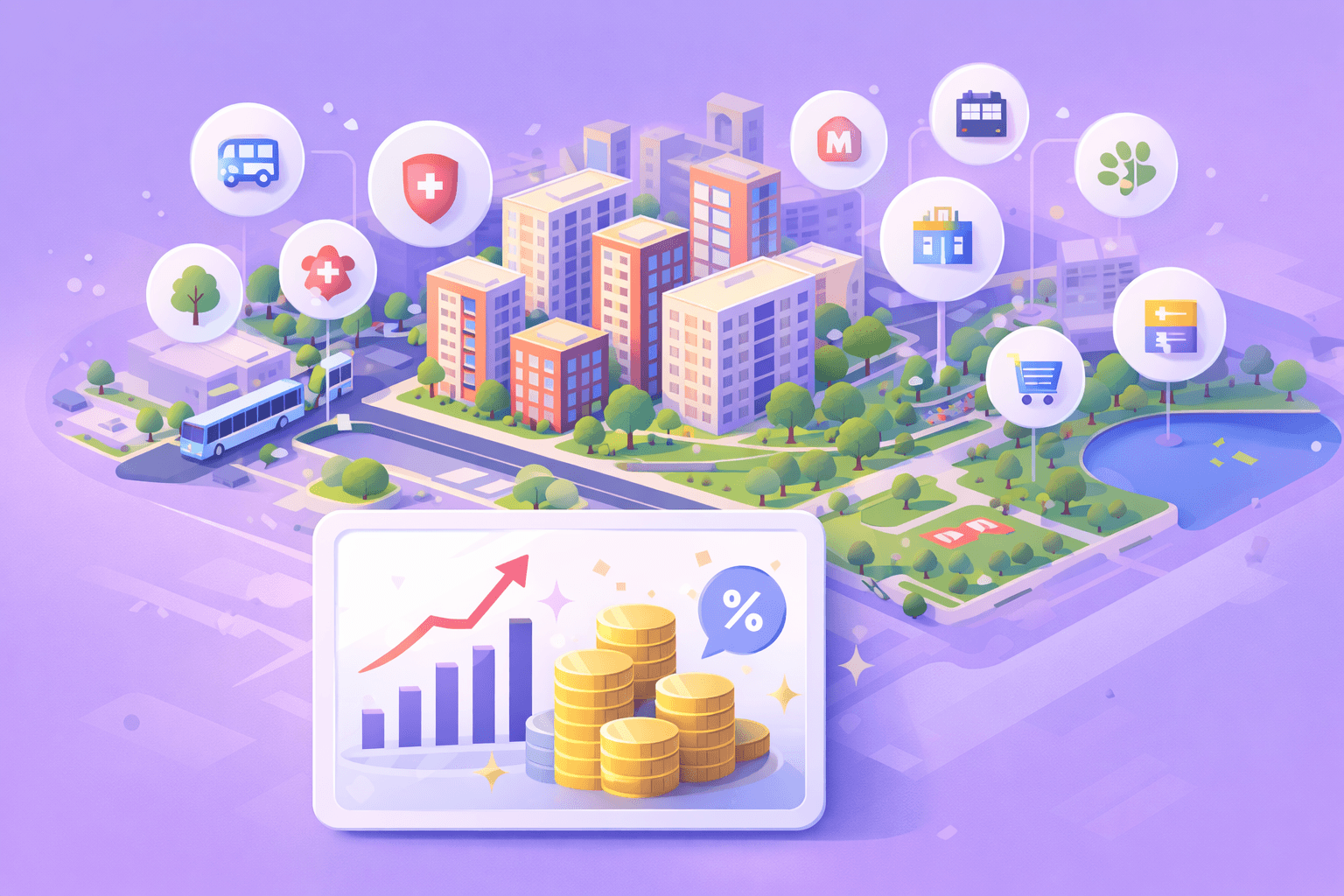
If we simplify the Polish evidence, the picture currently looks like this:
- transport, especially metro access in Warsaw, can add around 8–13%, and in some models up to 15%;
- nearby greenery can add around 2.8–3.1%;
- overall quality of life has a positive effect, but without one universal number;
- safety is a strong factor that often appears as a discount in worse areas;
- nearby water also increases location value, although usually without one simple percentage for all of Poland;
- a pet-friendly environment is better treated as part of greenery and local infrastructure.
Why these percentages cannot simply be added together
This is one of the most important points.
If a property is close to the metro, a park, good shops, and a riverfront, that does not mean you can just add all those percentages together into one big premium. These figures come from different studies, different cities, and often measure overlapping parts of the same location value.
Put simply, a good neighborhood is a system of factors that work together. And the market prices the overall quality of the location, not a mechanical sum of separate advantages.
The main takeaway
A neighborhood in Poland really does add value to housing, and research supports that. But it does not add value in a magical way or through one universal number. Prices rise because of specific things: good transport, nearby greenery, access to services, safety, and a well-functioning environment.
That is why looking only at apartment size, renovation quality, and price per square meter is too narrow. In many cases, the neighborhood is exactly what determines whether a property will turn out to be a genuinely good purchase or whether, a few years later, it becomes clear that the “cheap” apartment was actually an expensive mistake.