Why a Subjectively Pleasant Neighborhood Can Be a Bad Buy
Why a nice first impression of a neighborhood can be misleading when buying a home: transport, greenery, safety, services, and air quality.

Why a Subjectively Pleasant Neighborhood Can Be a Bad Buy
A lot of people judge a neighborhood in exactly the same way. They arrive during the day, walk around for 20 minutes, see a coffee shop, a few newer buildings, trees along the sidewalk, and quickly get the feeling that the area is good.
The problem is that first impressions are almost always shallow. They focus on visually pleasant details, but they are bad at noticing the things that actually affect both quality of life and property value: transport accessibility, noise, safety, access to services, air quality, and real green space. These are the factors that best explain the differences between neighborhoods.
First impressions respond to visuals, not daily reality
A neighborhood can look calm, clean, and comfortable. That creates the feeling that living there will be just as pleasant as spending 20 minutes walking through it on a nice day.
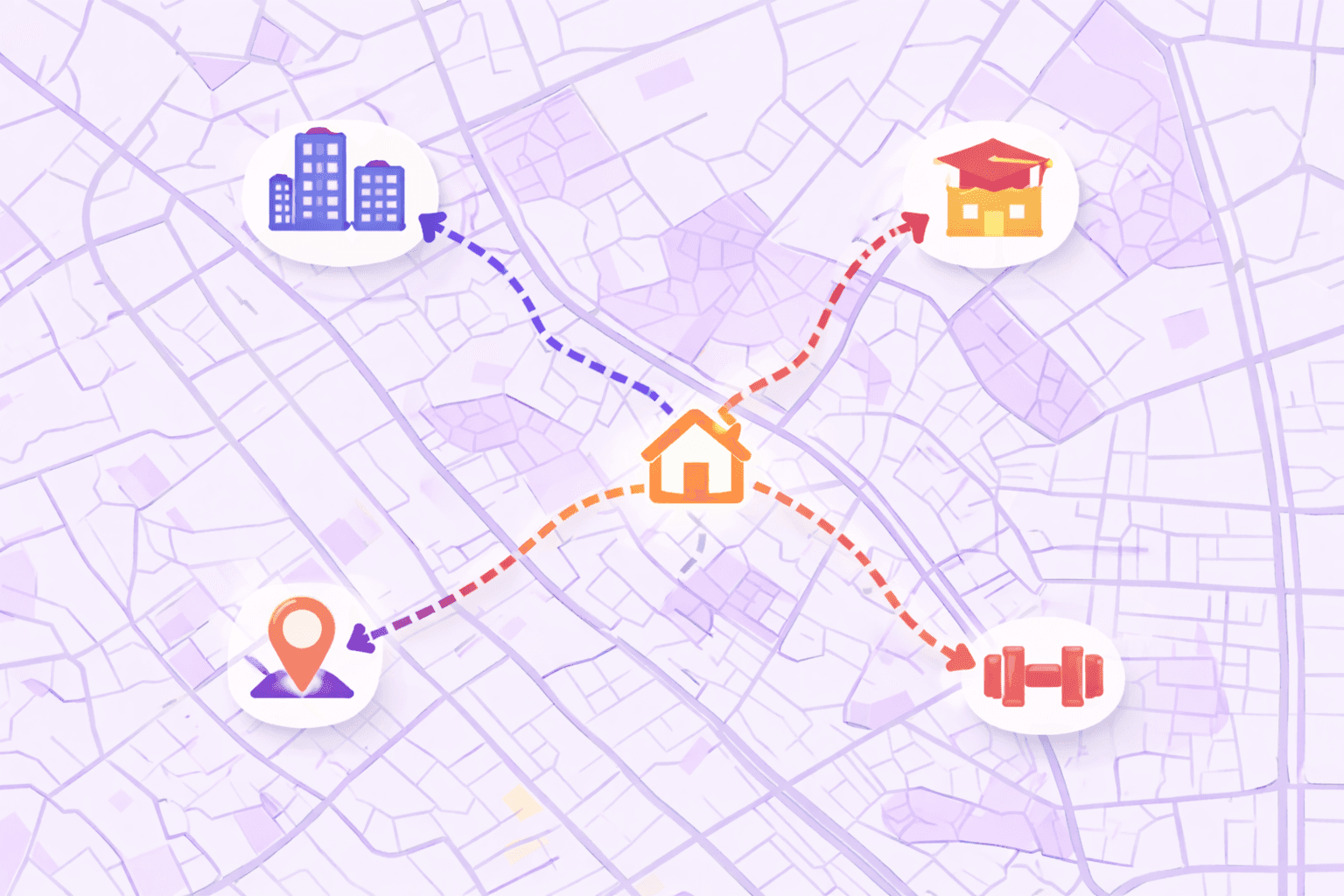
But buying a home is not a walk. It is daily life: commuting to work, getting to school, going to shops and pharmacies, dealing with evening noise, morning traffic, safety, and air quality in different seasons. And very often, those are exactly the things a first impression misses.
That is why a visually pleasant neighborhood and a genuinely convenient neighborhood are not the same thing.
Transport: charm does not help if getting around is hard
One of the clearest examples is transport.
A neighborhood may feel quiet and attractive, but if it is inconvenient to reach the rest of the city from there, the market reacts quickly. For Warsaw, research on the first metro line showed that the highest price premium appears for homes located within 400–800 meters of a station: around +8–13%.
That matters because accessibility is not just an abstract convenience. It is a factor that is directly capitalized into housing prices. If a neighborhood looks nice but is poorly connected, that is already a sign of a weaker purchase.
Greenery: feeling green is not the same as actually being green
There is another common trap. A neighborhood may feel green simply because there are a few trees in the courtyard, pleasant light, and a good-looking view from the window.
But the market reacts not to mood, but to the actual environment. When green surroundings were measured using transaction data in Warsaw, the results showed that having a green area within 100 meters increased housing prices by around 2.8–3.1% on average. For newer homes near greenery, the effect reached 8.0–8.6%.
So what matters is not whether an area feels green, but whether meaningful green space is truly part of the everyday environment around the home.
Safety: an attractive-looking area can still have a weak reputation
There is also the opposite situation. A place may look pleasant, but still be a weak purchase because of things that are not visible right away.
One of the most important examples is safety. Research from Szczecin shows a relationship between housing prices and crime levels across city districts. The authors started from the hypothesis that high crime negatively affects the secondary housing market, and the results confirmed a strong relationship between crime background and prices.
For a buyer, this means something uncomfortable but important. A neighborhood may appear neat, with decent facades and a calm street during a viewing, while still having a weak reputation that a first impression completely misses.
Air quality: the market itself does not always price the problem correctly
Another important point is that the market does not always evaluate everything correctly either.
In a Warsaw study based on around 15,000 observations, the authors expected high concentrations of PM10, PM2.5, and PM1 to reduce housing prices. In the end, however, they did not find a statistically significant effect on transaction prices.
This is a very important finding. Poor air quality can make life meaningfully worse even if the market does not yet apply a visible discount for it. That creates an uncomfortable situation: a neighborhood may seem perfectly fine on the surface, while objectively being a weak purchase because one of its key risks is underestimated by almost everyone.
Infrastructure: a quiet neighborhood is not always a convenient one
The same logic applies to infrastructure.
In Warsaw, research on access to urban services showed that neighborhoods with a higher accessibility index for healthcare, education, and public transport also had higher apartment prices. The city shows a very clear pattern: the weaker services are in peripheral areas, the less they support housing value.
In practice, this means something simple. A neighborhood may be tidy, quiet, and visually pleasant, but if everyday life there is inconvenient, that weakness becomes very noticeable over time.
Why the feeling of “I like it here” often misleads buyers
The biggest mistake when choosing a home is trusting only the feeling.
A “pleasant” neighborhood may simply be visually well packaged: fresh facades, nice weather on the day of the visit, a convenient route by car, and a short walk through one or two streets. All of this can easily create a false sense of quality.
But people do not buy a mood from one visit. They buy an environment they will live in for years.
That is why a neighborhood that feels good emotionally can still turn out to be a bad buy in terms of everyday life and long-term housing value.
What to check instead of relying on first impressions
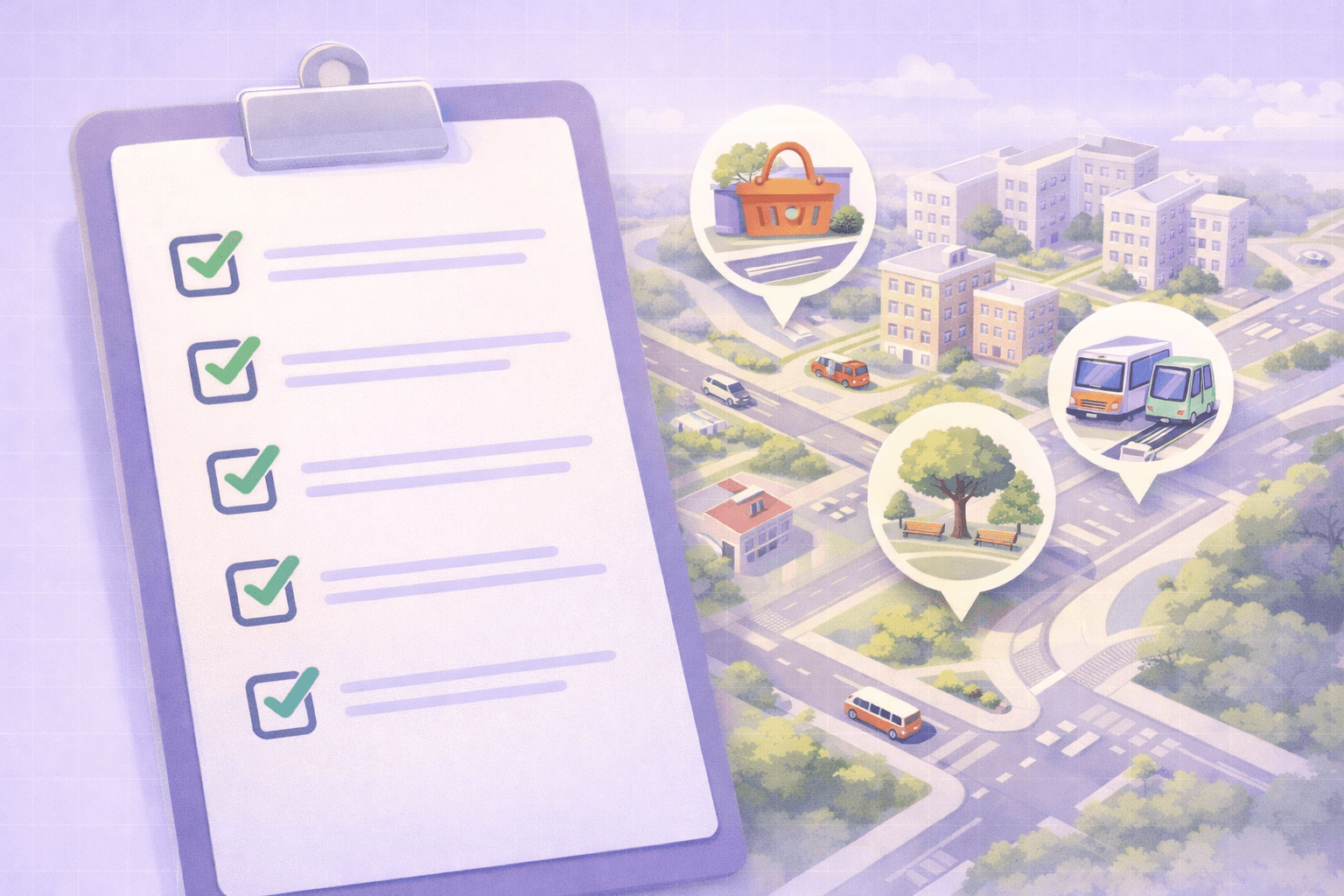
A neighborhood is better judged not by “do I like it or not,” but by a set of concrete questions:
- how easy is it to get around from here;
- which services are actually available in daily life;
- is there real greenery nearby, not just a few trees;
- are there noise risks;
- what is safety really like;
- what is happening with air quality.
These are the things that reveal the difference between a nice surface and a genuinely strong location.
The main takeaway
A first impression may help you choose a place for a walk. But it is not enough to choose a home.
A subjectively pleasant neighborhood can still be a bad buy if the attractive surface hides weak transport, poor access to services, noise, safety problems, or bad air quality. That is why, when choosing a property, it is better to trust not only your feeling, but also the data. That is what helps you understand what you are really buying.